Showing posts with label dental. Show all posts

Friday, January 29, 2010

Single Implant For An Actress

This young actress showed up at our clinic with a hopeless premolar on her right side.

As her job requires her to look good in front of the camera all the time, she cannot afford to go without a tooth.

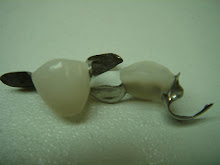
We extracted her tooth and inserted a tiny one-tooth Flexite immediate denture.

With pink coloured nylon claps and no coverage of her palate, she was able to look good before the camera and not have a denture plate interfere with her speech immediately after her extraction.

2 months after extraction, she came in for implant surgery. The healing was not very good and the bone quality not as good as we had wanted it to be, but we managed to insert a 4.5mmx8.5mm Osstem GSII implant into the space.

The extraction space after 2 months.
Healing is not perfect, making the surgery a challenging one.
The implant is in place.
The blue fixture mount was removed and the wound was stitched up.
She reported only mild discomfort after surgery and went straight back to work.
The restoration phase of the treatment will take place in 3 months.
We will post the updates then.


2 months post-op! Our beautiful actress showed up.
We relieved her of her Flexite denture, did a surgical exposure of her implant and attached an abutment to it.

Sorry, we were so excited we didn't clean up the area before taking this picture.
After that, we placed a temporary crown over the abutment.
We will wait another 2 weeks for the cut gums to heal, at which time we'll take impressions for the permanent crown.

Sorry, we were so excited we didn't clean up the area before taking this picture.
The finished product.
The patient had some reaction to the temporary crown material.
The inflammation is expected to clear in a couple of days.
A very daring super close up.
The gums have been pushed aside by the temporary crown.
They will soon settle in nicely with the new crown.
The patient has her tooth back.

Wednesday, January 27, 2010

Bonding In The House

This young lady was complaining about a discoloured tooth on her upper left side. We recommended bonding which not only masked the discolouration but changed the apparent positions of her instanding lateral incisors.

We have rounded off the sharp tips of her canines and roughened the surfaces of her 2 teeth to be bonded.

Her 2 lateral incisors are "in".

Bonding completed in less than 30mins. Front view.


Thursday, January 21, 2010

Malocclusion


Malocclusion may be seen as crooked, crowded, or protruding teeth. It may affect a person's appearance, speech, and/or ability to eat.

How to identify Malocclusion

Even though most people do not have perfect alignment of their teeth, for some, the misalignment causes other more noticeable problems. A dentist should be consulted if any of the following symptoms occur together with poor alignment of teeth, in order to effect a proper diagnosis and treatment of Malocclusion.
  • pain arising from pressure to the jaw
  • problems in speech and ability to eat
  • breathing through the mouth
  • difficulty in keeping the lips closed

Tuesday, January 19, 2010

Implant Restoration

The Dental Implant
The procedure is technically known as an endosseous implant.

The implant behaves like an artificial root on top of which a new artificial porcelain tooth can later be screwed in or cemented.

The implant is serted surgically in the existing jawbone and can remain in place for years.
The procedure to place the implant is a minor, two-step surgical process.

While some people express concern at undergoing minor surgery, the procedure is actually less invasive than having a tooth removed.

There is another significant, therapeutic benefit to implants: They prevent further bone loss and help maintain ridge form.

Monday, January 18, 2010

Things To Remember

Reminder!!!
  • Painful experiences in the dentist's chair childhood can contribute to dental phobia later in life.
  • There are different degrees of dental phobia. Most people are dental phobic to some degree.
  • Fear of the dentist keeps many people from scheduling appointments on a regular basis. Oftentimes, their oral health deteriorates as a result.
  • Dental phobia is often the product sessions that passed without incident and remember only those visits when the drill really did hurt us.
  • Only by acknowledging that you have dental phobia can you start to eliminate it.
  • Many dentists these days are learning ways to combat patients' phobias, and there a number who practice hypnosis, biofeedback, and other relaxation therapies.

The Smile In Your Future

There are people who are smile-challenged for another reason: They are ashamed of their teeth and gums.
They believe their smile is unattractive.

Perhaps their teeth are crooked, or stained from years of drinking beverages like coffee, tea, and cola, or from smoking tabacco.

Perhaps some teeth are chipped or missing.

Whatever the reason, by keeping their smile imprisoned behind their lips they deprive themselves of the most vital communication tool we have apart from speech itself.

If you're one of those people, the good news is that these problems can be corrected.

Learn more about how you can achieve the perfect smile you've always wanted.

Thursday, January 7, 2010

Mini Implants

Here are the recent patient questions on dental implants:
Q = Question ; A = Answer

Q: What are my options for implants?
A: The cheapest and uncomfortable would be denture.

Q: How long do dental implants last?
A: As to the longevity of dental implants, honestly at the present time we cannot answer this question.

Q: How much does mini implant cost?
A: About $2500.

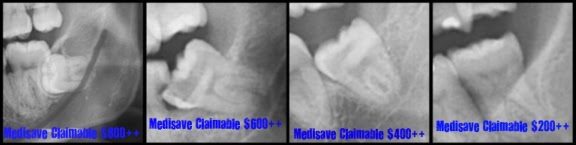
Q: Can i use my medisave to pay for it?
A: No. Unless you go for conventional implant.

Q: What is the dental implants procedure?
A: The first step in the decision for dental implants is to make an appointment with a qualified dentist for an evaluation. Dentist will examine your mouth and teeth and take a thorough medical and dental history. X-ray will be taken on the consultation day which will give the dentist a good idea of your bone density and the shape of your jaw. Dental implants is a process generally performed in the office with local anesthesia or light sedation to help make the patient more comfortable. Using precise, gentle surgical techniques, the implants are placed into the jawbone for 3 to 6 months while osseointegration takes place. This helps ensure a strong, solid foundation for replacement teeth. During this time, temporary bridges or dentures may be used to minimize any cosmetic or chewing inconvenience.

Q: Can i choose the type of anesthesia for dental implant surgery?
A: There's MUST on local anesthesia. But if you're require for general anesthesia, we will provide it for you too.

Q: Am i going to hospitalization?
A: Not necessary.

Q: What is the long-term success rate?
A: The simply answer to the long-term success rate of dental implants are that dental implants can fail, but fortunately very infrequently. Failure rates vary depending on the site in the mouth, whether they are placed into natural or grafted bone and whether the patient smokes. The overall success rates in natural bone is 95%, though this falls to between 85 and 90% in grafted bone. If a patient smokes it has been shown that they are statistically two and a half times more likely to have an implant fail than a non-smoker.


In order to better understand how mini implants work, it will be helpful to read about the history and current status of standard dental implants.

http://www.osseonews.com/standard-implants-vs-mini-implants-for-lower-overdenture/

Monday, January 4, 2010

What To Expect After Surgery

Take antibiotics and painkillers as prescribed by your dentist or oral surgeon.
The following tips will help speed your recovery.
  • Bite gently on the gauze pad periodically, and change pads as they become soaked with blood. Call your dentist or oral surgeon if you still have bleeding 24 hours after your surgery.
  • While your mouth is numb, be careful not to bite the inside of your cheek or lip, or your tongue.
  • Do not lie flat. This may prolong bleeding. Prop up your head with pillows.
  • Try using an ice pack on the outside of your cheek for the first 24 hours. You can use moist heat-such as a washcloth soaked in warm water and wrung out-for the following 2 or 3 days.
  • Relax after surgery. Physical activity may increase bleeding.
  • Eat soft foods, such as gelatin, pudding, or a thin soup. Gradually add solid foods to your diet as healing progresses.
  • Do not use a straw for the first few days. Sucking on a straw can loosen the blood clot and delay healing.
  • After the first day, gently rinse your mouth with warm salt water several times a day to reduce swelling and relieve pain.
  • Do not smoke for at least 24 hours after your surgery. The sucking motion can loosen the clot and delay healing. In addition, smoking decreases the blood supply and can bring germs and contaminants to the surgery area.
  • Avoid rubbing the area with your tongue or touching it with your fingers.

White Spot On Teeth


A number of factors can lead to the development of white spots on teeth.

Sometimes these spots are caused by nutrition, genetics, or an excessive intake of fluoride, while other times they become evident after braces have been removed. Some children also develop white spots on their teeth as they are developing.

Usually white spots that appear on the teeth are actually areas of decalcified enamel and sometimes this problem can actually lead to the deterioration of teeth. Some dentists will tell you that the first evidence of tooth decay is a white spot lesion and by this description they mean that the tooth’s enamel has taken on an opaque color in the area where the cavity is beginning to form.

White spots on the teeth can appear after changes have occurred in the mineral content of a person’s teeth. White spots can also appear in connection with a condition called fluorosis, which is the result of having an excessive intake of fluoride. People who live in areas where drinking water contains a high fluoride level often encounter this problem.

White spot lesions are also commonly attributed to having braces. People with orthodontic braces often have trouble properly brushing their teeth and the result is a build-up of plaque. The acids in plaque can severely harm tooth enamel and eventually cause cavities. The first evidence of this type of tooth decay is the white decalcified enamel spot or lesion that becomes apparent when braces are removed.

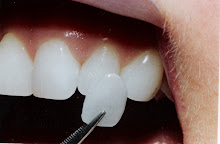
Treatment options for white spots on teeth can include fluoride treatment, bonding and porcelain laminate placement depending on the severity of the problem.

Most people do not realize that sometimes having bright, white teeth isn’t necessarily a good thing. So, if you haven’t been brushing and flossing but you’ve noticed your teeth are getting whiter keep in mind you might be well on the way to decay.


Above information are from this link.

Tuesday, December 29, 2009

Immediate & Conservative

Immediate implant placement after extractions has numerous advantages.

1. Implant placed immediately after extraction, so no extra surgery for the patient.
2. Bone and soft tissue preservation.
3. Option to do conservative flapless surgery.
4. Faster healing.

Biggest disadvantage:
Outcome highly dependent on skill of the surgeon. It is very difficult to drill into an extraction socket and place the implant in an ideal position.

This technique is also not suitable for teeth which show signs of chronic infection (cysts etc).

The middle aged female patient had a fractured post crown, upper left central incisor. A Flexite immediate denture was prepared for her on the day of the extraction.

Flexite denture on the cast.

Another view of the Flexite denture.

The crown was separated from the root.

We then extracted the root. It was difficult as we had to make sure that no bone was lost or damaged during the extraction.

The socket had excellent bone walls on all sides.
No chronic infection.
Conditions for immediate implant placement were fulfilled.

Dr Chan placing an Osstem GSII 4.5x10mm implant.

Good primary stability meant that we could place a healing abutment on top of the implant.

It's a bit closer to the lateral than the central, but the xray shows that the position was acceptable.

The temporary Flexite denture was tried in the mouth.
Note that no scalpels were used for this surgery.
We expect minimal pain, swelling and faster healing.

The implant should be ready for loading in 2-3 months.
Both bone and soft tissue should be well preserved for an aesthetic outcome.

Crouching Tiger Hidden Dragon @ New Age

A young and attractive childcare teacher cum part-time model turned up at our clinic with an interesting problem.

Her main complaint was tilted right incisor. She could not put on braces as it would affect her modelling assignments.

Apart from a tilted incisor on the right side, she also has a retained baby tooth in the canine position.

The tilted tooth affects her smile very significant.

An xray solves the mystery. The patient's permanent canine decided to lodge itself in the upper jaw bone directly above the right incisor. The "hidden dragon" pushed the root of the incisor backwards (palatally), tilting the crown of the same tooth forward (labially).

For those who are not familiar with xrays, we'ce traced the buried canine out for you.

The "hidden dragon" was surgically removed and the defect was filled with bone graft. The patient was pain free from the second day after surgery. We proceeded to do a root canal on the tilted tooth.

Here's the tooth with fibre post and composite core built up.

Shade matching was a challenge. We didn't want to follow the colour of her other teeth too closely as she may want to do something about the unsightly spots soon. She may also wish to extract her baby tooth and replace it with an implant.

And here is the temporary crown.

Stay tuned to see our emax crown when it's ready.

Periodontal Disease

Gum disease, or pyorrhea, should properly be referred to as periodontal disease; that is, a disease that affects those tissues surrounding the teeth.

Early signs of periodontal disease are first noticed in the gingival or "gum" tissues. If the disease allowed to progress, it may lead to recession of the gingival tissue, destruction of the underlying supporting bone, loosening of teeth, and eentually tooth loss. Periodontal disease is the number one reason for tooth loss in the adult populvation.

- The beautiful smile of Jessica Alba -
(She is an American television and film actress who born in Pomona, California)

The surface of healthy gingival tissue should appear pink, knife edged, and stippled like an orange peel. Various shades of pink may be characteristics of healthy tissue depending on the patient's ethnic background and skin tones. Stippling, the orange-peel-like appearance, may also vary according to age and sex.

- the healthy gum -

There are five cardinal symptoms of early periodontal disease that show up in the gum tissue: redness, tendency to bleed easily, tenderness, sponginess, and very slight swelling. Any one of these symptoms or all may be present at one time.

- Gum disease -

- Gum disease -

If any of the above mentioned symptoms occur in your mouth, seek your dentist for the treatment of the periodontal disease. The sooner the diseased state is detected, the sooner it may be arrested.